
Pulling Back The Curtain: ADORE
August 30, 2026
I’m on the fence about whether or not I should pull aside the curtain on the things I write. I think about David Lynch, who famously wouldn’t explain his films — not that I’m anywhere near on the same level. But I believe the words on the page should take precedence in storytelling more than “Word of God” (that is, words from the author outside the book). If it was important enough for the story, it should probably be there.
So in that sense, this post is trivia about ADORE’s creation and me rambling about some purposeful choices I made, for anyone who is interested in the author’s thought process. If that detracts from it… well, hopefully it doesn’t!
Maybe this goes without saying, but I’ll be openly discussing spoilers for ADORE. I recommend you read it first, but I can’t tell you what to do!
A Questionable Choice for Debut
I’ll be honest: ADORE was, perhaps, a strange choice for a debut.
There are a couple of reasons for this. Some personal, some not. I’m not sure what an indie debut typically looks like, but I imagine most are made with passion (you can be completely self-indulgent in indie, after all!), filled with things that would set a baseline for the author. Perhaps it’s meant as the thing that represents what their future work will be, just rougher and more novice at the edges before they truly polish their craft.
ADORE is… not that, for me. First of all, it’s a deviation from how I typically write romance, which is generally romantic first, then sex (if present). ADORE is more… well, there are hints of romance but sex happens first and then it’s also sort of romantic, but in a more vague sense even by the end. The main character, Riya, is reluctant to open herself up to a relationship due to her past. But to be clear there is an admission of love, it just never comes in a plain simple “I love you” form.
I also commit one of my personal peeves in this story, which is that there’s a relatively short timeline for romance to develop. A month isn’t the worst, but it also isn’t all that realistic, haha. There’s many egregious examples in media, so at least I have company.
And while I do enjoy sci-fi, I’m more partial to fantasy, though they’re essentially two sides of the same coin as speculative fiction. As far as sci-fi goes ADORE is quite soft, as I chose not to bog down the romance/character development trying to explain things more than I needed to. (Perhaps “bog down” isn’t the right wording; I’m sure some people would have appreciated more depth in that aspect).
I categorized it a “sci-fi romance” for that reason: the romance takes precedence over science fiction, though it might be more plot-heavy than other romances.
That’s not to say I hate it, or it doesn’t contain anything I personally like, or I didn’t try my best to make it a cohesive, thoughtful story. Far from it — I worked at it to the point I was sick of reading the same words over and over. And I like to think I achieved my primary goal with it, which is write something I enjoy while keeping it relatively snappy. Perhaps it was a bit too snappy, as the criticism I’ve heard thus far can mostly be boiled down to “wanting more”, just within the general universe or more exploration of X theme. This may be a natural consequence of it being a novella (despite it being a long novella).
The last thing I wanted for my debut was to bore the reader. In that respect, I think I succeeded — Amazon doesn’t give you too much data to glean anything from, but from Kindle Unlimited page reads, I can at least surmise that people who start it generally finish it. Usually in a day or two!
The more objective reasons I feel this was a questionable debut: I touch on a few sensitive topics in this story. For example, an aspect that was heavy on my mind: “how do you write a romance with a victimized sex worker love interest that starts sex-first and not make it read as exploitative”. How successful was I? It’s up to whoever is reading, I suppose. That said, I’m sure there’s problematic implications someone could cobble together, but it would be pretty boring if I refused to write challenging topics because someone might take issue. Trying to please every single reader is a losing game, anyway.
The characters have a different cultural background from myself (Riya, being Tamil/Singaporean), and to a lesser extent Adore/Ingrid, who was intended to look East Asian despite the unnatural hair color (but she’s an android, so ethnicity is kind of surface-level). In spite of the Western names, most characters are likely Asian simply due to location. Though I can’t really blame anyone for interpreting differently considering the setting is vague for a long time. I did some research, but I didn’t go super deep into cultural aspects, anyway.
ADORE was a side project that I came up with while working on my debut novel, but I opted to finish it first to get some experience self-publishing before committing to a fantasy series. I’ll introduce that project in a later post, but it’s going to be more “true to me” as a writer, I think.
But I must reiterate that I love ADORE for what it is: my experimental, unapologetically sapphic debut! I’ll delve a little more into my favorite parts of it down below.
My Writing Process
ADORE took me roughly 9-10 months from rough draft to final draft, and then I had to await the book cover and external editing before I could publish, so it came out roughly a year after I started it.
All my stories start out as a tiny seedling of an idea, basically just a concept. In this case: what if a mechanic fell in love with the android she was supposed to fix? And then it inevitably grows from there. Ideas are the easy part. All I need to do is go for a walk, or drive, or stand in the shower, and boredom leads to natural idea development. I’ve always had a pretty active imagination, so I envision whole scenes in my head.
The writing is the trickier part.
Sometimes it’s not so bad. Sometimes words just flow, and I get a lot done in short time. Other times it’s like pulling teeth.
When writing anything, I usually make a document to create thin outlines, like this:
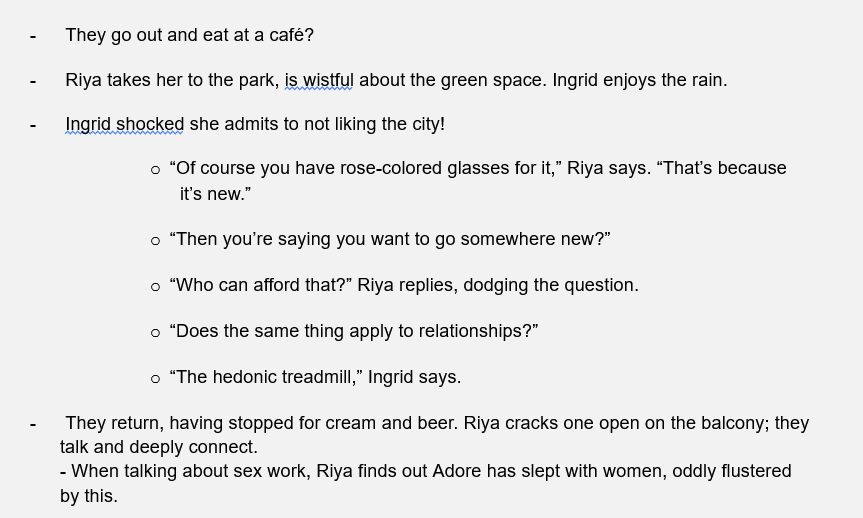
(It gets really sloppy because it’s meant for my eyes only; it’s not even proper English sometimes.)
…But I’m not afraid of switching things around or changing plans as the story goes on. It’s funny because you can see some lines actually make it past the sloppily-written outline and into the final product, while some things disappear, like the hedonic treadmill conversation.
I’ll also throw in notes or even full scenes if they come to mind before I’ve reached that point in the story. It’s a little chaotic, but it works for me!
First vs Final Draft
ADORE was not the easiest to write. It exhausted me, maybe because it was my first original story with the intent to publish. I really tried hard to make it an enjoyable read! In the first draft I nearly failed this, and it started to become a meandering, odd story by the end, and there were a few times I wanted to give up on it.
I also made the horrible mistake of writing in present tense then switching to past before finally deciding which tense I wanted. That made it an extra headache to edit.
But, well, you can see that I did make it through despite the difficulty! I’ve never struck out on a draft quite like this one; I’ve had some small changes to make in past fics, but this is the first time I needed to overhaul a hefty chunk of the story — the second half, mostly.
In the original draft, Riya and Ingrid slept together first and then Amir showed up the day later, and Ingrid threatened him with the gun in the apartment. There was no second confrontation where they had to go to the club before leaving. It all just sort of… wandered aimlessly, where they went to the airport, hung out at the beach, and then got on the ferry. It just wasn’t very satisfying!
Speaking of the initial sex scene, I had a difficult time writing it. Riya was conflicted about it, desiring Ingrid while at the same time feeling guilty due to her being forced into sex work. And, as mentioned before, I had to make it feel non-exploitative on a meta level. The end result may not be perfect, but it did get better over each draft and is placed better in the timeline after things got rearranged.
Sometimes, you have to say “good enough” and carry on! (This is a lesson I still need to learn. I spend so much time tweaking my writing, it’s certainly diminishing returns on how much I can make it better).
Anyway, for anyone interested, here’s ADORE’s opening in the first draft vs the final draft:
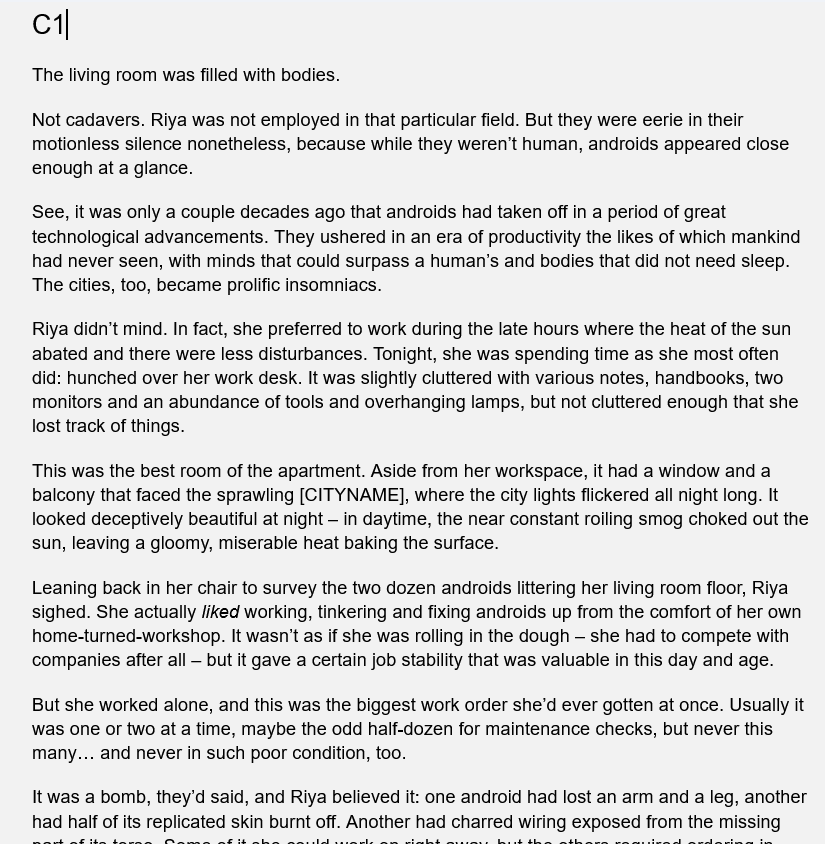
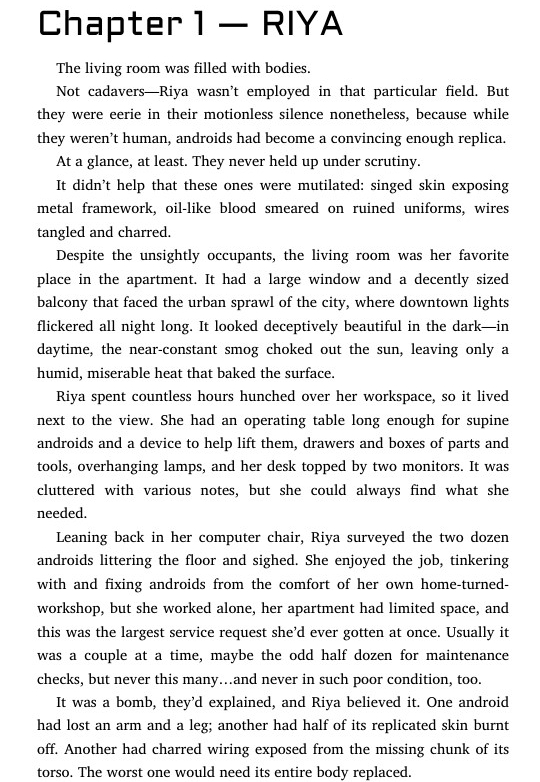
As you can see, it stayed pretty similar! I’m not particularly good at hook-y lines, but I like the opening line here, so it persisted throughout. The following lines I troubled over for a while, especially in terms of sentence rhythm and punctuation, haha.
While they’re similar, I like to think the final version is improved. Looking back, I despise the whole paragraph that starts with “See,” — it’s very tell! Most of what I did to clean up the first few pages was removing superfluous world details and try to focus more on Riya and her surroundings. If it was important enough, the worldbuilding could be brought up later, but it’s hard to get a reader invested if they have no reason to care about the main character yet.
Author Notes
I would hate to be the author saying “this is how you’re supposed to interpret something” — I think there’s a lot of value in a reader’s perspective. They bring up ideas that may not have been intentional, but are an interesting interpretation regardless. They get to be part of the story-making process in a way.
So, I don’t want to be an author that overexplains what I meant. I don’t always try to avoid “what did the author mean by this?” as a question. Sometimes I just let some lines exist for readers to draw their own conclusions about rather than making everything concrete, though hopefully not enough that it becomes detrimental to the book and the reader’s experience with it.
Notable Writing Choices
I’m not supremely clever or sneaky about how I go about writing; I’m rather straightforward, I would say, in most aspects. I’m more ambiguous with some worldbuilding, but overall, I’m not doing anything crazy. Maybe I’ll get crazier as I grow as an author, haha.
That said, I wanted to make a little section to highlight intentional choices that probably won’t even be noticed by most readers (at least in a conscious sense).
I guess one of my notable (but noticeable) choices was to never refer to the location by name. There are small hints, and then a blatant mention of Changi added on a near-final draft, but ADORE takes place in Singapore. Riya never calls it that — to her it’s just “the city” — and why wouldn’t it be? She hasn’t known any other city. This isn’t a super important choice, but it was intentionally done, so here is me making note of it. To be fair Singapore doesn’t have much of an identity within the story beyond the city-state status and a few minor references.
I don’t feel super compelled to discuss my writing decisions regarding Riya. Maybe because she’s the main character? We’re in her head the whole story, so I’m hoping most of her thought process is understandable. I think the only things that I never mention directly but could easily be gleaned are: 1. She has a (negative) bias toward men 2. She has a guilty conscience re: women because of the crimes she was unwittingly part of in the past.
For ADORE, I think most of the notable writing choices would be related to… well, Adore/Ingrid. I’m a fan of multi-POV, but I opted to write solely Riya’s POV for this story. Mostly to lower complexity as this was meant to be a novella, but also because I think ambiguity on Adore’s perspective was sort of the “meat” that had to be dug into, at least in the first half. I wonder if this potentially caused some distrust on the reader’s end, though — for the romance to have believability, you have to trust that Ingrid is being honest without ever getting to know for sure. Kinda like Riya.
Secondarily, it’s a little harder to write a non-human perspective. Ingrid was meant to replicate one (and canonically has a human mind, of sorts), so I could probably get away with writing her mostly humanlike. It’s not that I wouldn’t want to! I like writing offbeat perspectives and enjoy reading xenofiction.
Regardless, I knew I didn’t want to write the androids as super robotic in dialogue or otherwise, so there wasn’t going to be a rule like not using contractions (a la “I am not sure” vs “I’m not sure”). Natural sounding prose is one of my highest priorities, especially in dialogue, so I’d be hard-pressed to write a main character like that.
That’s not to say I didn’t consider Ingrid’s distinctions as an android. A minor thing I did to differentiate her was the fact that she never uses filler words in her dialogue, except in one instance of the story. While Riya’s is full of “um”s and “uh”s, Ingrid doesn’t bother. Perhaps that goes against my own “she’s meant to be like a human” philosophy, though it’s more like she’s meant to be like a human with the rough parts sanded off. Anyway, I just thought it was a fun way to show her “superior” processing, so to speak.
As for the one time she uses “um”:
“What did Amir say to you, the night he brought you in? He leaned in and whispered something.”“Oh, um…”
Riya’s eyes narrowed at the android’s unusual hesitation.
Ingrid looked furtive as she answered, “‘As soon as you’re fixed, we can start a new life.’”
“A new life?”
“He wants us to leave,” Ingrid explained, running her thumb over a fold in the blanket to flatten it. “After you fix me.”
(I believe this is the only “um” Ingrid ever uses. She’s more hedging in general during this conversation, because via my own writer’s intent she knew that the more she explained to Riya, the more she might feel compelled to get involved.)
The other thing I paid attention to is that Ingrid is more precise about her language. This rule may not have been followed 100% of the time as it’s a lot more subjective, but there were certain sentences where I thought a lot about the wording. Some examples:
“I fell.”“You fell?” Riya repeated, incredulous.
“Yes. After that, I became more…aware.”
[…] “Is that really all?”
“I suffered cranial trauma. I’m not lying about that,” Adore stated.
…Okay, this one is pretty in-your-face. I wasn’t that concerned whether the reader thought something was amiss or not, so it could be easily caught. She’s lying about falling being the cause, but she isn’t lying about suffering cranial trauma. Hence: “I’m not lying about that”.
The next passage is kind of long so I won’t post the entirety, but for context Riya accuses Ingrid of not always being honest, and this is Ingrid explaining why:
[Ingrid] shifted under the blanket and fiddled with the strings of the hoodie she was wearing. “Some things might make you uncomfortable; you’re very expressive when something bothers you.”Riya made a face but allowed her to continue without interruption.
“And some other things might end up…” The pause was notable to Riya. “…implicating someone beyond myself.”
“Interesting choice of words, there,” Riya remarked. “Who are you protecting?”
Amir, surely. But why would she cover for him?
This one is slightly more covert, if only because the POV character makes her own wrong guess of what Ingrid means, haha. Ingrid worrying about “implicating someone beyond herself” could very easily refer to Amir after it’s revealed he’s been mistreating her in many ways — but in actuality she’s referring to Riya, correctly assessing that if told the whole truth, Riya might involve (implicate) herself.
I also tried to keep Ingrid more “grammatically correct”, though I broke this on occasion in preference for more natural-sounding dialogue. For example, using “may I” vs “can I”… near the end of the story, she asks “Can I touch you?” and I couldn’t bring myself to write it “May I touch you?” because it just sounded too formal in that situation.
So, that was some insight into the little rules I invent while writing characters (and how I choose to break said rules)!
Personal Thoughts
I’m happy with the finished story overall, but I always wonder if there’s something I could do better, or about other things I’d have liked to explore if I was aiming for a novel.
One thing I ponder a lot about is how much I should delve into sensitive subjects in stories. ADORE discusses domestic abuse (and to a lesser extent parental abuse, with Riya’s mom) and it’s a connecting thread between the two main characters, but it’s only mentioned in dialogue. Or shown with more subtle implications, such as Riya’s more paranoid/on edge demeanor, or her getting tense when there are hands near her neck.
I don’t want to shy away from subjects just because they’re difficult, but I also don’t want to veer too dark where it could feel glorifying or gratuitous. I probably made the right call with ADORE as it is marketed as a romance and it’s already darker than most (I hope the fact it’s sci-fi romance at least excuses this somewhat; it was never going to fully follow typical romance beats).
Something I would’ve liked to touch on more is Riya being a class traitor of sorts, and the class conflict in general. Within the story there’s tension because androids take jobs when many people are unemployed. Riya isn’t rich, but she does profit from fixing the androids who are taking these jobs. There is some minor implication of it when she says she’s selling shovels in a gold rush, but it’s not explored much deeper.
I had a few lines in my outline document which discussed it a bit: “It’s not out of the goodness of my heart. I’m as selfish as any human,” Riya admits. Ingrid’s praise has scalded her in a way, enough that she is compelled to expose the shiny skin underneath. “I profit off of androids.”
A deleted line: “That’s why the rich love ‘em. How could anyone ever compete? High upfront cost, free labor for years.”
And another:
“Maybe, with all this funding, they could’ve done something good for humanity,” Riya says. “But no. They’ll displace humans from work for the sake of profit, and then they—” She hesitates a second, “—they make you, something so impressively close to human, and then they use you for sex. They could’ve made the world a better place, and instead they reinvented slavery.”
Who knows. Maybe this can be recycled elsewhere!
The thing about books is that they’re so subjective, like all art. Someone can read something and love it, and the next person will hate it. As the author, I’m sure I have unavoidable bias, though I don’t think I could ever hate what I’m making — at that point, why would I make it?
I definitely lean more towards doubting my work than anything, though. I’m pretty hard on myself as a creative, and always think my work could be better. For ADORE, I often lacked confidence in it.
But I wanted to mention the chapter where I actually grasped that elusive joy as a writer where I felt I nailed what I was aiming for. Does that mean it’s perfect? Definitely not. But I was proud of it, and therefore, I call that chapter my favorite (Chapter 8).
ADORE is chopped into three “acts” despite being relatively short (the only delineation of this is them having the chapter titles with the character names) although they aren’t super distinct. But the end of Chapter 8 marks the halfway point of the story, and it’s the chapter where the two main characters are completely honest with each other. Everything from then on is, well, dominoes falling afterwards!
Anyway, I want to highlight my two favorite passages from it. This one:
Ingrid regarded her fondly. “You really do love fixing things.”“I don’t think it’s a matter of love,” [Riya] said wryly, handing the dish to Ingrid. “When people are destructive, you just learn to get good at it.”
Ingrid shook her head. “I think it is.”
The line about destructive people was one I’d had basically since the conception of the story idea, but the surrounding matter came in as I wrote it. I think it says a lot about the characters in a short amount of time, and I’d love if I could always be so concise! I hope what comes through here is the difference in their perspectives; Ingrid finds Riya admirable for repairing things, while Riya argues that it’s just the circumstances of her life that led her to be this way.
Is fixing something inherently an act of love (as opposed to discarding, replacing, etc)? Ingrid would argue yes.
As for my favorite scene of the chapter, it’s the end of it:
“Ingrid. When you said you fell, were you telling the truth?”Ingrid bit her lip. After a stretch of seconds, she shook her head. It was a tiny movement, but it was enough.
“What happened?”
“I’m not sure it’s kind to burden you with it.”
“I’m not asking if it’s kind.”
Ingrid tended to look elsewhere whenever she was measuring her words. “Amir gets agitated, especially when he’s high. That time, it was…I don’t know.” She took a shaky breath. “He kept telling me to say I loved him like I meant it. But he wasn’t convinced no matter how many times I said it, so he—he threw me against the wall, and then…” Her mouth twisted. She was unwilling to finish.
“And that only happened one time?” Riya asked tersely. All her personal bitterness was replaced with furious concern.
“Androids don’t bruise,” Ingrid repeated in lieu of a direct answer. “Androids don’t bruise.”
Riya worked her jaw. Long ago, she promised herself that she’d only use anger productively, and her hands itched with the need to do something. To fix it. But all she could do now was wrap her arms around Ingrid’s taller shoulders and pull her close.
Riya knew then that she was, inextricably, the wrong person for this job.
(I like the entire interaction, but for brevity’s sake I just cut it to the last part).
Anyway, as I mentioned, this scene marks a significant turning point for the story, and it’s the only time I truly felt I captured the tone and emotion exactly how I wanted. My only dilemma was how explicit I wanted Ingrid to be about the abuse; I could’ve dug in deeper, but it would have disturbed the pacing of the scene somewhat, and I was unsure how much readers would tolerate hearing of male partner abuse in a sapphic romance. There is also something to say about the common horror tactic of never letting you see the monster: I left it up to the reader’s imagination, which could be better or worse than what I would have wrote.
Bonus: Cut Content
When I write I have a tendency to picture all sorts of scenes and jot them down, whether it’s in chronological order or not. Sometimes it’s just a line or two, and I may or may not have a place to incorporate it in the actual story.
Actually, a line I mourn a bit ended up becoming the tagline, though it was removed from the story proper: “Beyond love, isn’t violence the most human thing of all?”
I liked the line, but I didn’t like its place in the story! And I never quite found a place for it to fit, so at least it lives on in some form.
I’ll also share some larger snippets that didn’t make the cut. The following passage is specifically about Riya confronting Ingrid about her flirtation later in the story. I do like it, but it was removed from one of the drafts and never made a return:
“Why do you keep saying things like that?” Riya garbled out, half complaint, half pained.Ingrid giggled, like she was delighted that she was acknowledging it. “Hm? I like the way you react. It’s cute.”
“That’s the only reason?” Riya asked dourly.
“Should there be more?”
“No,” Riya said. “I don’t know. You should mean what you say.”
She wasn’t sure what she was griping about, or why she even offered Ingrid the upper hand of knowing it bothered her. Before, it had simply felt inappropriate, and now it was even worse, because Riya… shouldn’t be falling for it.
Ingrid was silent for a moment. “Who says I don’t?”
Riya did not dignify that with a response.
The next passage was specifically at the second last chapter, where Ingrid now says “I’ll miss you if you leave”:
“You have the power to hurt me.”Riya’s brow furrowed. “What do you mean?”
“It would hurt me if you left,” Ingrid admitted, folding her hands together.
This is a callback to Riya saying “love is giving someone the power to hurt you” — so again, it’s another indirect confession of love. The line that replaced it is still supposed to convey the same thing, just less blatantly (and of course, Riya quite literally gives Ingrid the power to hurt her by removing her constraints. This used to be more blatantly expressed in past drafts, too).
The next list is a pile of one-liners I wrote, maybe themes I might have wanted to explore but never got to:
- How precious would a life be if it lasted forever?
- Human connection is harder than ever to find, these days.
- “I don't know if I'd called sycophants a net positive for romance.” (This one does get explored a bit, just not so blatantly!)
Other things that didn’t make the cut:
“Maybe you can never be a human,” Riya said, with some urgency. “Maybe… you can be something greater.”
This was meant to be a semi-romantic statement, but I never did have a clear idea where it should go. So it never made it in.
The next passage refers to the androids that Riya’s fixing over the story:
“What happened to them?” Ingrid pursed her lips. “You never said.”“Some sort of bomb at a factory,” Riya answered. “I didn’t ask for details. But, ah…”
“Why would someone do that?”
Riya sighed. “I mean, I don’t know. The investigation is ongoing, but I assume it was one of those anti-android attacks. People are struggling and fed up and looking for something to blame.”
“Enough to hurt sentient beings?” Her eyes were half-lidded, and her expression was somber.
Riya cracked a wan smile. “When has sentience ever stopped humanity from causing pain?”
This one I basically melted into all of two sentences in the final version, where Riya wonders why Adore/Ingrid bothers reading books:
“You actually read it?”“Yes. Why do you ask?”
Riya studied her. “Surely you have the capability to load a summary of any book in that big, intricate brain of yours.”
Adore stared for a moment before giving her a look of mild reproach, lips pushed out. “Is that really the same experience? In that case, why does any person watch or read anything when they could just read a summary?”
Riya shrugged. “I don’t imagine the human brain can comprehend things as fast as an android. Surely a summary for you could be more like knowing the entire thing.”
“You’re asking ‘why bother experiencing anything as intended’? Really?” Adore teased.
She had her there.
“I’m not sure how smart you think I am,” Adore added with a small frown, “but we have limits. Ignoring easier data access, we’re not dissimilar in capabilities.”
“I’d bet you’re smarter than the average person.”
“Perhaps,” Adore admitted. “Better than average is acceptable—expected for an android—but there’s a point where it would become alienating.”
I do kind of miss this passage, if only because it’s the one that explains that the androids are smart but not to an extreme extent. Instead, Riya just mentions this once in her thoughts. It was cut partially because I didn’t like its location for pacing/tone reasons, but also because the message behind it felt a bit too anvilicious to me.
“There’s a difference between simulation and actually feeling something,” Riya points out. “You’re saying you actually, truly feel these things?”Ingrid’s smile is edged with something sharper than usual. “Yes. How am I meant to prove that?”
“You don’t,” Riya mumbles. “I just wanted clarification.”
Honestly, this passage is probably an example of one I created without much thought of where it’d be placed, and it’s kind of a hostile interaction, so it was probably early on in the story.
“I’m as woman as you want me to be,” Ingrid answers with a smile.Riya scoffs at that.
“I don’t know how it’s meant to feel. I’m in a designed body, but I don’t have an attachment to gender beyond how it makes humans treat me. But that’s the significant thing, isn’t it?”
Another thing I may have touched on more with a longer story: Ingrid’s gender, or lack thereof. She’s not a woman, even though she presents very feminine (willingly) and is treated as one (unwillingly)! She is arguably nonbinary, but this doesn’t get explored much in the final version beyond Ingrid saying outright that she’s not a woman. Not as a major struggle, just that she doesn’t have any connection to gender in a traditional sense.
Finally, I could’ve discussed the whole “do robots have a soul” aspect more. This was in the book, to be fair, but it could’ve gone deeper. The response is essentially if it feels real, then it is real.
And I’ll leave it at that! I’m sure I could find more to ramble about, but I’m not sure if anyone will even care to read something this long about an indie author’s first book. I wanted to make this post regardless, so here it is.
As for ADORE… is this the end?
Perhaps not. My traitorous mind has already come up with a sequel of sorts (kind of standalone, but it would revisit the characters of ADORE). I’m not making any promises, especially because I’m not sure ADORE is even popular enough to justify a sequel, but if I get hit by the inspiration beam enough maybe there’ll be more of this universe regardless! It’d be about an android/android pair, so maybe I won’t dodge writing android POV forever.
(Psst. As a gift to anyone who read this far, here’s a link to the bonus chapter of ADORE (🌶️) that I’ll be using for a reader magnet.)